4-Week At-Home Workout Plan: Minimal Gear + Stretches
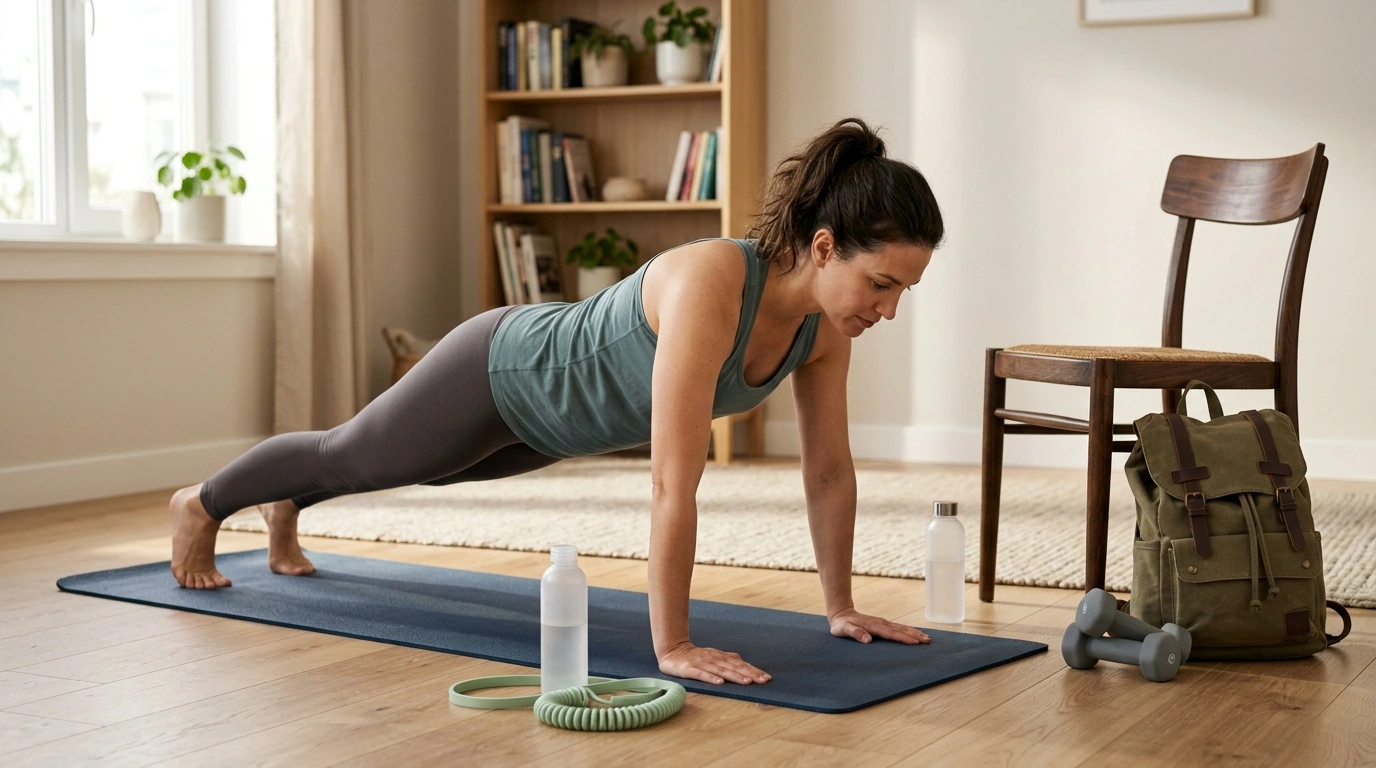
Fit at Home: A 4-Week Minimal-Equipment Workout Plan with Daily Workouts and Stretches
A structured four-week plan makes home training easier to follow and easier to progress. The goal is simple: show up, move well, build strength and conditioning with minimal equipment, and use short daily mobility to keep your body feeling ready for the next session. This plan uses a repeatable weekly rhythm, clear effort guidelines, and small weekly upgrades so results come from consistency—not guesswork.
What this 4-week plan helps improve
- Full-body strength using bodyweight plus a few optional add-ons (band, light dumbbells, chair/bench, loaded backpack).
- Cardiovascular fitness with low-space conditioning options like intervals, circuits, step-ups, and brisk walking.
- Core stability and posture through bracing, anti-rotation work, and glute/upper-back activation.
- Mobility and flexibility via short daily stretch sequences that fit before or after training.
- Consistency with a weekly structure that progresses across four weeks without changing everything at once.
Minimal equipment setup (and smart substitutions)
- Essentials: exercise mat or towel, water bottle, timer/phone, and a stable chair.
- Highly useful add-ons: resistance band loop or long band; light-to-moderate dumbbells or a loaded backpack.
- Easy substitutions: backpack instead of dumbbells; towel sliders on smooth floors; stairs for step-ups; countertop for incline push-ups.
- Space check: clear enough room for a plank and a lunge step, then keep one “training corner” ready to reduce friction.
How to use the plan (duration, intensity, and progression)
- Session length: 25–45 minutes including warm-up and cooldown. If you feel good, add 5–10 minutes of easy cardio on strength days.
- Weekly rhythm: 3 strength-focused days, 2 conditioning/low-impact cardio days, and 1–2 recovery or mobility days.
- Intensity guide: on strength sets, stop with about 1–3 reps “in reserve.” Conditioning should feel challenging but sustainable.
- Progression options: add 1–2 reps per set, add one extra set, shorten rest slightly, or choose a tougher variation.
- Form-first rule: only level up when technique stays controlled (steady tempo, stable trunk, and pain-free range).
For broader weekly activity targets, the CDC physical activity guidelines are a helpful benchmark. For strength training principles, see ACSM resistance training recommendations.
Weekly schedule template (repeat for 4 weeks)
- Day 1: Strength A (lower body + push + core)
- Day 2: Conditioning (intervals or brisk incline walk) + short stretch
- Day 3: Strength B (hinge + pull pattern + core)
- Day 4: Mobility/Recovery (easy walk, light yoga flow, longer stretch)
- Day 5: Strength C (full-body circuit) + finisher
- Day 6: Conditioning (low-impact cardio circuit) + stretch
- Day 7: Rest or gentle mobility (5–15 minutes)
4-Week Progression Snapshot (example structure)
| Week | Strength focus | Conditioning focus | Daily stretch focus |
|---|---|---|---|
| Week 1 | Learn movement patterns; moderate volume | Comfortable intervals; build habit | Short full-body mobility (5–8 min) |
| Week 2 | Add reps or one extra set | Slightly longer intervals or less rest | Hips/ankles + thoracic mobility |
| Week 3 | Harder variations or added load | Include one higher-intensity segment | Hamstrings/glutes + chest/shoulders |
| Week 4 | Consolidate: best form, steady effort | Choose favorite conditioning format | Longer cooldown stretches (8–12 min) |
Daily workout building blocks (simple menu to plug in)
Warm-up (3–6 minutes)
Cycle through marching in place, arm circles, hip hinges, bodyweight squats, gentle lunges, and scapular push-ups. Aim to feel warmer, looser, and more coordinated—not exhausted.
Strength staples (pick 4–6 moves)
- Squat or split squat
- Hinge (RDL/backpack deadlift)
- Push-up or incline push-up
- Row (band row or backpack row)
- Glute bridge or hip thrust (shoulders on chair optional)
- Plank or dead bug
Conditioning options (10–20 minutes)
- 30/30 intervals: 30 seconds work, 30 seconds easy for 10–16 rounds (step-ups, shadow boxing, fast march).
- EMOM: every minute on the minute for 10–15 minutes (pick 2–3 low-impact moves and rotate).
- Brisk walk: steady pace outdoors or in place; add stairs if available.
Core finishers (3–6 minutes)
- Side plank (short holds, perfect alignment)
- Hollow hold regression (tucked knees) or dead bug
- Pallof press (band) for anti-rotation
- Bird dog with slow tempo and pauses
Stretching and mobility: a quick daily sequence
Post-workout works best: hold each stretch 20–40 seconds for 1–2 rounds with relaxed breathing. For general flexibility guidance, the NIH stretching basics provide a solid overview.
Common obstacles (and quick fixes)
Gear and downloads to make this easier at home
- Fit at Home: 4-Week Workout Plan (PDF eBook with daily workouts and stretches) for day-by-day structure you can keep on your phone or print.
- Wireless Bluetooth Headband with HD Stereo Speakers to keep music or timers going without earbuds falling out during floor work.
- Dinosaur Alarm Clock with Voice Control and Night Light as a simple “same time every day” cue for early workouts or consistent wind-down stretching.
Compare related options such as Effortless Cordless Electric Spin Mop with Water Sprayer & LED Headlight to match features, dimensions, and use case before choosing.
FAQ
How many days per week should the plan be followed for best results?
Aim for 5–6 active days per week (3 strength days, 2 conditioning days, and 1 mobility/recovery day) with at least 1 full rest day. If your schedule is tight, prioritize the 3 strength days and add conditioning when possible.
Is minimal-equipment training enough to build strength?
Yes—strength can improve steadily at home by progressing reps, sets, tempo, and single-leg variations, and by adding load with bands or a backpack when ready. The key is repeating the main movement patterns and making small, consistent upgrades week to week.
When is the best time to do the daily stretches?
Right after workouts is ideal because your tissues are warm and you can relax into longer holds. Evening stretching also works well for recovery, while a short dynamic warm-up is better before training.











Leave a comment